

 Floor Hendriks
Personality test: Big Five · from €104.00
Personality translated into work-related competencies.
Red represents strength, blue represents calm, and yellow represents creativity. The Caluwé test translates this symbolism into a powerful tool that maps out your personality and work style. This test uses six different colors to determine how you think, act, and collaborate within organizations.
Imagine that your colleague always starts new projects full of energy (yellow thinking), while you prefer to work out all the details first before you begin (blue thinking). These differences often cause friction, but the Caluwé Colors Test shows that you complement each other perfectly. By knowing your personality color, you’ll not only understand yourself better but also learn how to collaborate most effectively with others.
What you’ll learn in this article
- The six colors and what they mean for your personality
- How the test works and what it measures
- Practical applications in work and personal life
- Differences from other personality tests
- Tips for getting the most out of your color profile
What exactly is the Caluwé color model?
Professor Léon de Caluwé developed this test to measure how people think about change and collaboration. The test is based on the belief that every person has one or two dominant “thinking patterns,” which can be translated into colors.
The test doesn’t measure what you can do or what you know. It examines how your brain processes information and makes decisions. For example, do you think logically first (blue), or do you jump right in (red)? This preference determines your color profile.
What makes this method unique is that there are no right or wrong answers. Each color has valuable qualities that organizations and teams need. A successful team combines different colors to effectively address all aspects of a project.
The test was developed based on years of research into change processes in companies. De Caluwé discovered that conflicts often arise because people put on different “lenses” when looking at problems. By making these lenses visible through colors, teams can collaborate more effectively.
The six colors explained
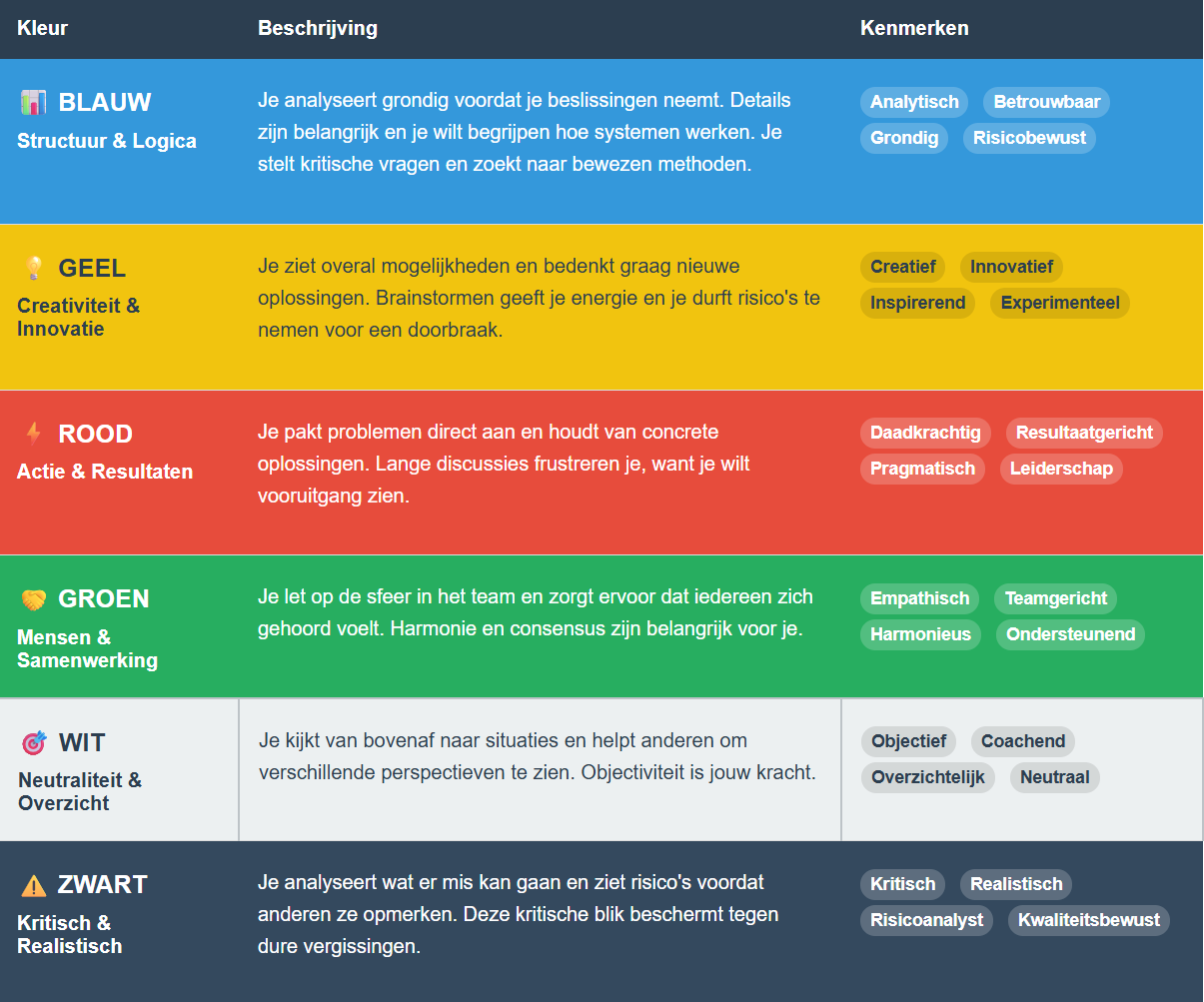
Blue Thinking
People with a blue thinking style value structure and logic. You analyze thoroughly before making decisions. Details are important to you, and you want to understand how systems work.
A blue thinker first examines all available data. You ask critical questions and look for proven methods. In meetings, you’re the one who asks, “Have we researched this?” or “What are the risks?”
This thorough approach has major advantages. Projects you lead usually have a solid foundation. You prevent costly mistakes by thinking things through in advance. Colleagues appreciate your reliability and expertise.
The downside is that you sometimes wait too long to take action. While you’re still researching, the opportunity may have already passed. Other colors can help you act more quickly when the situation calls for it.
Yellow Thinking
Yellow thinking stands for creativity and innovation. You see opportunities everywhere and enjoy coming up with new solutions. Brainstorming energizes you, and you’re willing to take risks to achieve a breakthrough.
As a yellow thinker, you’re often the first to ask, “Why don’t we do it differently?” You dislike routines and are constantly looking for ways to improve. You inspire others with your enthusiasm for new ideas.
This trait makes you valuable in situations that require change. You see opportunities that others miss and aren’t afraid to experiment. Startups and innovation projects desperately need your way of thinking.
The challenge for yellow thinkers is completing projects. You quickly get excited about the next idea before the current one is finished. Collaborating with blue or green thinkers helps you actually carry out your ideas.
Red Thinking
Red stands for action and results. You tackle problems head-on and prefer concrete solutions. Long discussions frustrate you because you want to see progress.
Red thinkers are natural leaders in crisis situations. You make decisions quickly and motivate others to take action. “Let’s just do it” is your motto. This attitude ensures that projects actually get completed.
Your strength lies in turning plans into results. While others are still talking, you’ve already gotten started. This pragmatic approach often yields quick successes.
The risk is that you’ll act too quickly without fully considering all the consequences. Collaborating with blue thinkers helps you avoid overlooking important details. Thorough preparation prevents you from wasting time later on solving avoidable problems.
Green Thinking
Green thinking focuses on people and collaboration. You pay attention to the team’s atmosphere and make sure everyone feels heard. Harmony and consensus are important to you.
As a green thinker, you see the person behind the employee. You understand that good results come only when people feel engaged. In conflicts, you look for solutions that are acceptable to everyone.
This people-oriented approach builds strong teams. Your colleagues feel safe to make mistakes and share ideas. This leads to greater creativity and engagement within the organization.
The downside is that you sometimes compromise too much. Not every situation allows for endless discussions about everyone’s opinion. Learning from “red thinkers” helps you make difficult decisions when necessary.
White Thinking
White thinking stands for neutrality and a broad perspective. You view situations from a bird’s-eye view and help others see different perspectives. Objectivity is your strength.
White thinkers are natural coaches and advisors. You ask the right questions, enabling others to arrive at insights on their own. In complex situations, you help bring structure to the process without taking sides.
This skill makes you valuable in change processes. You can weigh different interests against one another without becoming emotionally involved. Teams rely on your objectivity to make better decisions.
The downside is that you sometimes come across as too distant. People also want to know what your own opinion is. Learning to take a stand at the right moment strengthens your influence.
Pessimistic Thinking
Pessimistic thinking analyzes what could go wrong. You spot risks and problems before others notice them. This critical perspective protects organizations from costly mistakes.
Pessimists ask the tough questions that others prefer to avoid. “What happens if this fails?” or “Have we really thought this through?” Your skepticism leads to better decisions.
This trait is indispensable for important projects. You prevent teams from sailing blindly on a wave of optimism. By identifying problems early on, solutions can be devised before it’s too late.
The challenge is not just to point out problems, but also to contribute to finding solutions. Pure criticism without alternatives demotivates teams. Combine your realism with constructive suggestions.
How does the color test work?
The test consists of various statements, and you’ll be asked to indicate to what extent you agree with each one. There are no time limits, because the test measures your natural preference, not your speed.
A typical question is: “When solving problems, I start by gathering all available information.” You indicate whether this is completely true, somewhat true, or doesn’t apply to you at all.
The questions are designed to measure your automatic responses. It’s not about what you think is right, but about what you do spontaneously. That’s why honesty is crucial for a reliable result.
After completing the test, you’ll receive a color profile. This shows your primary color (usually 30-40% of your profile) and your secondary colors. Most people have two dominant colors that together define their work style.
Practical Application
Working in a team
Teams work better when they understand their color distribution. A project team consisting solely of yellow thinkers generates many ideas but achieves little. A team consisting solely of blue thinkers analyzes thoroughly but lacks creativity.
The ideal composition combines different colors: yellow for innovation, blue for analysis, red for execution, and green for collaboration. Each team member contributes based on their strengths.
Conflicts often arise from color differences. The yellow thinker wants to experiment, while the blue thinker wants more research. By recognizing this as a color difference rather than a personal conflict, teams can discuss issues more constructively.
Project leaders can assign tasks based on color preferences. Let the blue thinker conduct the risk analysis and the red thinker oversee the schedule. This improves both quality and satisfaction.
Leadership Style
Your color profile determines your natural leadership style. Red leaders make quick decisions and expect immediate results. Green leaders involve everyone in decisions and ensure consensus.
Both styles have their place, depending on the situation. In crisis situations, red leadership works better; during complex changes, green leadership is more effective. By knowing your profile, you can consciously switch between styles.
Also learn from other colors. A natural red leader can learn to put on the green glasses sometimes. Involve your team more in decisions when support is important. This increases your effectiveness as a leader.
Guiding Personal Development
The test reveals where your natural talents lie, but also where you can grow. Perhaps you’re strong in analysis (blue), but you can learn to act more quickly (red).
Development doesn’t mean changing your personality. It’s about expanding your repertoire. Stay true to your strong colors, but also practice other patterns for situations that call for them.
Consciously choose situations that challenge your weaker colors. As a blue thinker, occasionally participate in brainstorming sessions (yellow). As a yellow thinker, push yourself to see plans through to completion (red). This practice will make you more versatile.
Making Career Choices
Different professions suit different color profiles. Financial analysts often have a lot of blue, creative directors a lot of yellow, and project managers a lot of red. But these aren’t hard and fast rules.
Look at the core tasks of a position and compare them to your profile. Does the job require a lot of creativity while you’re primarily analytical? Then the work will be more exhausting than if it matched your profile.
Look for roles that leverage your strong colors but also challenge your weaker ones. This fosters growth without burnout. A job that’s a perfect fit for you can become boring after a while.
Differences from Other Personality Tests
The Caluwé Colors Test distinguishes itself from tests like the MBTI or DISC through its focus on change and collaboration. While the MBTI measures personality types, the Colors Test examines thought patterns within organizations.
DISC measures behavior in social situations. The color test goes deeper by examining how you process information and make decisions. This makes it more specifically applicable to work-related situations.
Another difference is flexibility. MBTI is based on fixed personality types. The color test recognizes that people can develop different patterns. Your profile can change through training and experience.
The test is also less categorical. Instead of placing you in a single box, you receive percentages for each color. This provides a more nuanced picture of your personality.
Scientific Basis and Reliability
Professor de Caluwé based his theory on extensive research into change processes in organizations. He analyzed hundreds of cases to identify patterns in how people respond to change.
The test has been validated across various cultures and organizations. Studies show that the results are stable over time, yet sensitive enough to measure development.
Universities use the test in their management programs. Major consulting firms apply it in organizational development. This widespread acceptance demonstrates its scientific rigor.
A word of caution: no personality test can perfectly predict behavior. The color test provides insights, not absolute truths. Use the results as a starting point for development, not as an unchangeable judgment.
Common Mistakes and Misconceptions
“My color determines what I’m capable of”
This is a dangerous misconception. Your color profile reveals your preferences, not your limitations. A blue thinker can learn to be more creative, and a yellow thinker can become more structured.
“I need to improve my weak colors”
Development doesn’t mean eliminating weaknesses. Focus first on further developing your strong colors. These give you the most return and energy.
"All yellow thinkers are the same"
There is enormous variation within each color. Two yellow thinkers can be very different. The test provides general guidelines, not a detailed portrait.
"The test tells me what kind of work I should do"
The test provides guidance, not rules. Successful people in every role have different color profiles. Much depends on how you apply your colors.
Making the Most of Your Color Profile
Start by accepting your natural profile. Don’t fight your dominant colors-learn to use them consciously. Know when you need analytical blue and when action-oriented red works better.
Develop an awareness of situations that require different colors. An important presentation might call for more red (decisiveness) even if you’re naturally green (consensus-oriented). Practice this flexibility.
Seek out complementary partners. If you’re strong in yellow (creativity), work with people who excel at blue (analysis) or red (execution). This will increase your collective effectiveness.
Use the language of colors to communicate more effectively. Instead of saying, “You’re too slow,” say, “This calls for more red thinking.” This makes feedback less personal and more constructive.
The Caluwé Colors test offers a powerful way to better understand yourself and others. By knowing your profile, you can make more conscious choices in your work and collaborations. The secret lies not in having the “right” colors, but in cleverly combining different thinking patterns.
The benefit of this insight extends beyond just work. In personal relationships, it helps you understand why people react differently. A red person wants to act immediately, while a green person wants to talk first. Both approaches have value.
By appreciating and combining different colors, we create stronger teams and achieve better results. The test shows that diversity in ways of thinking is an asset, not a problem to be solved.
Frequently Asked Questions
Can my color profile change over time?
Yes, your profile can gradually shift through experience and conscious development. Your dominant colors usually remain stable, but the proportions may change. Retaking the test every few years can provide new insights.
Are some colors better than others?
No, every color has unique value. Successful organizations need all colors. It’s not about better or worse, but about the right mindset for the right situation.
How long does the test take?
The average test time is between 15 and 30 minutes. There is no time limit, so take your time to answer honestly. Rushed answers lead to less reliable results.
Can I use the test for recruitment?
Yes, but use it as part of a broader selection process. The test reveals thinking preferences, not competencies or experience. Combine the results with other selection methods to get a complete picture.
Discover your personality now with our personality test and learn how to use your unique thinking patterns to achieve greater success in work and life.
Put this insight into practice
Take the assessment directly, or discuss the right approach with a specialist.
Also interesting: Motivational drivers test · 360-degree feedback · DISC test