
 Floor Hendriks
The 4Gs of Feedback
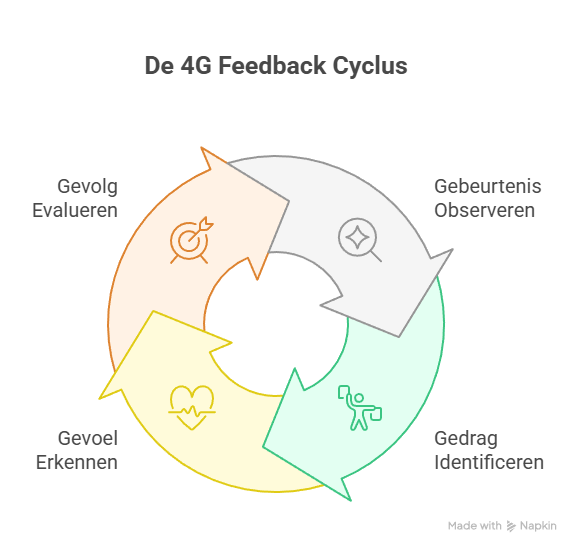
is a proven and simple method for providing clear, honest, and constructive feedback. The model helps you make conversations less personal, less emotional, and, above all, much more concrete. The 4Gs stand for Incident: Behavior: Feeling: Consequence
, and are used in evaluations, performance reviews, team communication, and 360-degree feedback.
 Would you like to collect feedback in a more professional and structured way? Then check out hrmforce’s 360-degree feedback assessment.
Would you like to collect feedback in a more professional and structured way? Then check out hrmforce’s 360-degree feedback assessment.
What are the 4Gs of feedback?
Put it into practice
360-degree feedback · from €114.00
Feedback from colleagues, managers and clients.
The 4G method helps make feedback concrete and respectful. You move step by step from factual observation to impact and desired behavior. The four components are:
- Event: What actually happened? (without judgment)
- Behavior: What specific behavior did you observe?
- Feeling: How did that make you or others feel?
- Consequence: What is the impact on work, results, or the team?
Why does the 4G feedback method work so well?
Many people find feedback nerve-wracking, precisely because it can quickly feel personal. The 4G model prevents this by:- starting objectively (Event)
- staying specific (Behavior)
- adding empathy (Feeling)
- identifying the business impact (Consequence)
The 4Gs Explained Step by Step
1. Event, what actually happened?
This is the objective starting point. You stick to the facts, without emotion or interpretation. Examples:- “During Monday’s meeting, the report wasn’t ready.”
- “Yesterday, you joined the client call 20 minutes late.”
- “Last week, three deadlines were missed.”
2. Behavior: What specific behavior did you observe?
Here, you specifically describe what someone did or failed to do. No labels, no character assessments-just behavior. Examples:- "You didn’t provide an update on the status of the assignment."
- "You interrupted your colleague several times during the meeting."
- "You didn’t get in touch to let us know you’d be late."
3. Feeling, how did that make you or others feel?
By describing your feelings, the feedback becomes more human. It shows why it’s important. Examples:- "That made me feel stressed about the schedule."
- "I didn’t feel taken seriously."
- "The team became uncertain because it wasn’t clear who was doing what."
4. Consequence, what impact does the behavior have?
This step clarifies why the feedback matters and why change is necessary. Examples:- "If reports are missing, we can’t make decisions on time."
- "Interruptions make colleagues afraid to share their ideas."
- "As a result, the customer perceives us as unreliable."
Example: 4G feedback in one sentence
Example 1: Late Delivery : “During last week’s presentation (Event), you hadn’t finished the slides yet (Behavior), which made me feel anxious about the client (Feeling), and we didn’t come across as professional in the presentation (Consequence).” Example 2: Interrupting a colleague : “In Tuesday’s meeting (Event), you interrupted a colleague twice (Behavior). That made the team feel unsafe (Feeling), causing people to be less willing to share their ideas (Consequence).” Example 3: Positive Feedback "During the sprint review (Event), you took the lead in answering customer questions (Behavior), which gave everyone confidence (Feeling) and created a very professional impression (Consequence)." https://www.youtube.com/watch?v=wtl5UrrgU8c&pp=ygUMNGdzIGZlZWRiYWNrComplete 4G Feedback Questionnaire
Below is a set of questions that you or your colleagues can use to provide concrete feedback using the 4G method.Questions About the Event
- When did you first notice something?
- What exactly happened?
- When and where did it take place?
Questions about behavior
- What exactly did the coworker do?
- What specific behavior caught your attention?
- What was said or done?
Questions about feelings
- How did this make you feel?
- What did you feel or experience as a result of that behavior?
- How did others react to that?
Questions about consequences
- What was the impact on the outcome?
- How did it affect the team or the client?
- Why is it important to discuss this behavior?
4G Feedback: Do’s and Don’ts
Do’s
- Describe only behavior, not character.
- Keep feedback brief and specific.
- Always ask for the other person’s response.
- Use the 4Gs for positive feedback as well.
Don’ts
- Don’t use labels (“You’re always so…”).
- Don’t bring up old frustrations.
- Don’t make assumptions (“You must have meant…”).
- Don’t make assumptions about intentions.
Applying 4G Feedback in Organizations
The 4G method works in:- performance reviews
- POP meetings
- team feedback
- performance reviews
- 360-degree feedback
- Daily collaboration
Do you want to organize feedback more professionally?
The 4Gs of feedback provide a strong foundation, but for deeper behavioral insights, development advice, and objective reports, you can use a professional tool. Check out hrmforce’s 360-degree feedback assessment here for a comprehensive feedback experience, including behavioral indicators and reports.Put this insight into practice
Take the assessment directly, or discuss the right approach with a specialist.
Also interesting: Personality test: Big Five · Motivational drivers test · DISC test