The Big Five Personality Model: What Is It and How Can You Use It?
Personality models are increasingly being used in the human resources industry. By administering a
personality test to a candidate or employee, you gain a clear picture of his or her personality. You can use this insight to determine whether a candidate is a good fit for your company, which role this candidate is best suited for, and to assess whether an existing employee is in the right position within the organization.
There are various personality models that you, as a human resources manager, can utilize. One of the best-known and most popular models is the Big Five personality model. You can read more about this model on this page.
Why the Big Five Model Is the Gold Standard
The Big Five personality model distinguishes itself from other models through its scientific foundation. Decades of research have shown that these five dimensions are universal and transcend cultural boundaries. This makes the model reliable for organizations that operate globally.
| Advantages of the Big Five |
Practical value |
| Scientifically validated |
Reliable predictions about job performance |
| Culturally neutral |
Applicable to international teams |
| Dimensional (no types) |
Nuanced picture without stereotyping |
| Stable over time |
Long-term planning possible |
The Big Five Personality Model: A Brief Introduction
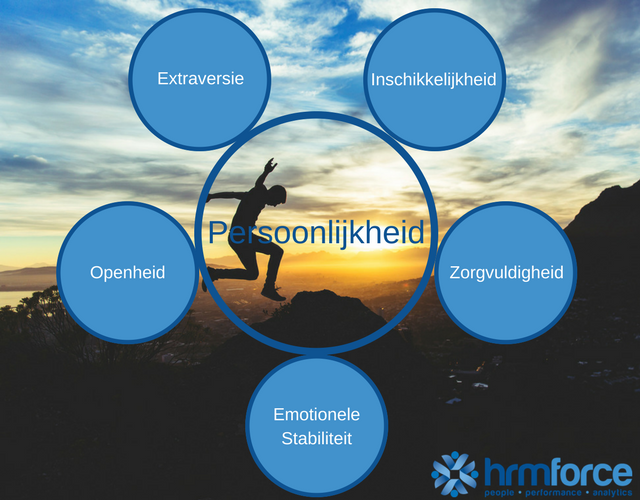
The Big Five personality model is a model based on five personality traits. The model is used in psychological research, as well as in recruitment and selection, analyzing and resolving workplace conflicts, and coaching. It is also a valuable tool for human resources managers.
An important characteristic of the Big Five personality model is that the scores on the five personality traits follow a normal distribution. People who take this test are not pigeonholed. For example, they can be somewhat introverted and at the same time somewhat extroverted. This makes the Big Five personality test very reliable and therefore useful.
How does the Big Five personality model work?
As mentioned earlier, there are five personality traits according to the Big Five model. These traits are briefly described below.
The five dimensions in detail
| Dimension |
High-score characteristics |
Characteristics of a low score |
Ideal roles |
| Extraversion |
Social, energetic, assertive, optimistic |
Calm, reserved, independent |
Sales, management, PR |
| Agreeableness |
Cooperative, trusting, empathetic |
Competitive, skeptical, direct |
Teamwork, healthcare, HR |
| Diligence |
Organized, reliable, disciplined |
Flexible, spontaneous, creative |
Administration, project management |
| Emotional stability |
Calm, confident, able to handle stress |
Emotional, concerned, sensitive |
Leadership roles, crisis management |
| Openness |
Creative, curious, intellectual |
Practical, traditional, conventional |
R&D, design, consulting |
Extraversion
Extraversion refers to the extent to which a person does or does not need social interaction. Extraverted individuals are sociable, active, and talkative. Introverted people prefer to work alone in a quiet environment.
Agreeableness
Agreeableness is also referred to as friendliness in the Big Five personality test. This is the extent to which a person is accommodating, tolerant, and helpful. A less agreeable person is often more competitive and sometimes less cooperative.
Conscientiousness
Conscientiousness refers to the extent to which a person works in an organized and goal-oriented manner.
Emotional Stability
Emotional stability refers to the extent to which a person is or is not emotionally stable. If someone is not emotionally stable, that person is neurotic.
Openness
Openness generally refers to the extent to which a person is willing and able to speak openly, but in the Big Five personality test, this concept means something else. In this case, openness refers to the extent to which a person is open to new experiences and/or new ideas. People who score high in this category are often somewhat more flexible than those who score lower.
How Scores Are Interpreted
The Big Five model uses percentile scores that indicate how someone scores relative to the general population:
Score interpretation:
Very high (90-100%):
Extreme in this trait; strong behavior in this direction
High (70-89%):
Clearly present, but not extreme
Average (30-69%):
Balance between both extremes
Low (10-29%):
Limited presence
Very low (0-9%):
Barely present, behavior in the opposite direction
A Personality Test Without Categories
As mentioned earlier, the Big Five personality test doesn’t pigeonhole people. For example, you might be a little extroverted, a little conscientious, and a little open to new experiences and ideas.
After taking the test, you’ll see exactly what your scores are for each personality trait. If your score is very high or very low, you fall into one of the extremes for that trait. In this case, for example, you’re not particularly extroverted at all. If your score is average, then you’re a little extroverted, but not very much.
https://www.youtube.com/watch?v=lc7vN_e36Yc
Practical Applications by HR Process
The Big Five model can be used in various HR processes. Each application requires a specific approach:
| HR process |
Relevant dimensions |
Specific applications |
| Recruitment & Selection |
All five dimensions |
Job fit, cultural fit, team composition |
| Career Development |
Openness, Diligence |
Learning preferences, career paths |
| Team building |
Extraversion, Agreeableness |
Role Distribution, Communication Styles |
| Leadership Development |
Extraversion, Emotional Stability |
Leadership Style, Stress Management |
| Conflict Mediation |
Agreeableness, Emotional Stability |
Communication Approach, Sources of Tension |
Using the Big Five Personality Model: Tips
Would you like to use the
Big Five personality test
in your organization? If so, we’d be happy to offer a few tips on how to use this test effectively when screening candidates and assessing your staff, particularly job applicants.
Tip 1: Give your interviewee time to take the test
It’s a shame if the Big Five personality test is rushed through, simply because the test is less reliable in that case. Be sure to tell your interviewee not to spend too long thinking about the questions and answers in the test. Thinking too much actually reduces the likelihood of reliable answers.
Tip 2: Choose a reliable test
. There are many companies that offer the Big Five personality test. Not all of them provide a reliable test. By choosing a reliable and validated test from a reputable provider, you can be sure that you’ll be able to conduct a thorough assessment. This is important because only a thorough assessment provides a clear picture of a person’s personality.
Tip 3: Discuss the test
Did you have an existing employee within the organization administer a test to a candidate for an open position? If so, don’t forget to discuss the test. The raw test results are interesting, but someone’s comments on these results are even more so. For example, ask whether he or she agrees with the results, or whether he or she recognizes themselves in the results. Also, ask follow-up questions: Why is your conversation partner actually like this? What does he or she think about this? Is this a good or bad thing?
By asking questions about the results of the Big Five personality test, you’ll gain an even clearer picture of your conversation partner’s character. This makes the personality model even more valuable in your work as a human resources manager.
Additional Implementation Tips
Tip 4: Combine with other information
Never use the Big Five as the sole selection criterion. Combine the results with competency-based interviews, references, and work experience to get a complete picture.
Tip 5: Train your HR team
Make sure HR staff know how to interpret and discuss test results. Misinterpretation can lead to discrimination and poor decisions.
Tip 6: Respect privacy and transparency
Be transparent about the purpose of the test and how the results will be used. Respect the right to privacy and store results securely.
Avoiding Common Mistakes
These mistakes are common when using the Big Five model:
| Common mistake |
Why It’s Problematic |
Better approach |
| Viewing scores as absolute truth |
Leaves no room for growth or change |
Using scores as an indication |
| Considering only extreme scores important |
Average scores also contain valuable information |
View all scores in context |
| Overemphasizing a single dimension |
Simplifying complex personality |
Taking a holistic view of all dimensions |
| Not discussing the results |
Missed opportunity for deeper insight |
Always conduct feedback and reflection sessions |
Sample profiles for various roles
These profiles provide an indication of which scores are often associated with success in specific roles:
| Role |
Extraversion |
Agreeableness |
Conscientiousness |
Emotional Stability |
Openness |
| Sales Manager |
High |
Average |
High |
High |
Average |
| Bookkeeper |
Low |
Average |
Very high |
High |
Low |
| Creative Director |
High |
Average |
Average |
High |
Very High |
| HR Business Partner |
High |
High |
High |
High |
High |
| Software Developer |
Average |
Average |
High |
High |
High |
Note:
These profiles are indicative. Successful professionals may excel in various areas. Use these as a guideline, not as strict criteria.
Scientific Background and Validity
The Big Five model is based on decades of research and has proven to be the most robust personality model:
| Validity Aspect |
Big Five score |
Meaning |
| Test-retest reliability |
0.80-0.90 |
Very stable results over time |
| Predictive validity for job performance |
0.20-0.40 |
Significant prediction of success |
| Cross-cultural validity |
95%+ of cultures |
Universally applicable model |
| Genetic basis |
40-60% hereditary |
Stable biological basis |
ROI of Big Five implementation
Organizations that effectively implement the Big Five model see measurable results:
Measured benefits:
25% reduction
in employee turnover with better job-person fit
15% improvement
in team effectiveness through deliberate team composition
30% higher
employee satisfaction with appropriate roles
20% faster
onboarding through targeted development plans
Checklist for Big Five implementation
For organizations looking to get started with the Big Five model:
Pre-implementation checklist:
☐ Define clear objectives for its use
☐
Choose a validated, reliable test provider
☐ Train the HR team in interpretation and interview techniques
☐ Develop privacy and data protection protocols
☐ Determine which roles/processes are suitable for assessment
☐ Create a communication plan for employees
☐ Establish evaluation criteria for implementation success
Conclusion
The Big Five personality model offers organizations a scientifically grounded method for assessing personality. Through the five dimensions-Extraversion, Agreeableness, Conscientiousness, Emotional Stability, and Openness-HR professionals can make better decisions regarding recruitment, development, and team composition.
The model stands out for its reliability, cultural neutrality, and practical applicability. Unlike typologies, the Big Five does not pigeonhole people but provides a nuanced picture that leaves room for growth and development.
Key points to remember:
Scientific basis:
The Big Five is the most well-validated personality model available
Practical value:
Direct applications in all HR processes
No labeling:
Dimensional approach respects individuality
Culturally neutral:
Applicable in diverse organizations worldwide
ROI-driven:
Measurable improvements in team effectiveness and employee satisfaction

 Floor Hendriks