
 Floor Hendriks
You’ve probably been there. A meeting gets bogged down, even though everyone shares the same goal. By understanding communication styles, you can reduce misunderstandings, conduct feedback sessions more effectively, and make team agreements that really stick.
In short
- Communication styles are preferred patterns in how someone speaks, listens, makes decisions, and reacts under pressure.
- Miscommunication often arises from differences in interpretation, not from bad intentions.
- Under stress, people are more likely to revert to their preferred style. This increases friction within teams.
- Assessments can help you identify communication styles. This aids in recruitment, onboarding, and development.
- The greatest benefits come from establishing agreements on language, pace, level of detail, and forms of feedback.
What do we mean by communication styles in the workplace?
Communication styles describe how someone processes and conveys information. You can see it in word choice, pace, level of detail, and the way someone expresses tension or resistance. So it’s not just about “how you talk,” but also about how you listen, how you ask questions, and how you support or, conversely, hinder decisions. In teams, communication styles are particularly noticeable in three situations: during coordination, when giving feedback, and during conflict. In calm times, differences seem minor. As soon as the pressure rises, those differences become more pronounced. That’s exactly why this topic comes up so often in HR when it comes to turnover, collaboration issues, and leadership challenges. If you want to link communication styles directly to measurable data and HR processes, take a look at how online assessments can help.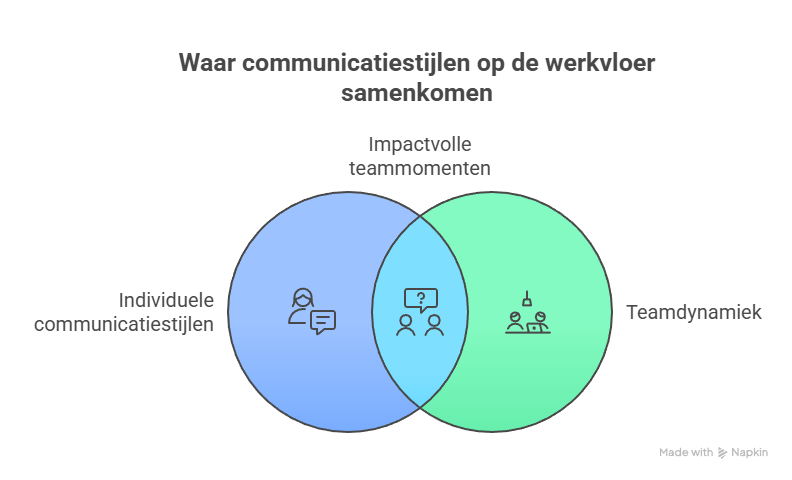
Which communication styles do you see most often in teams?
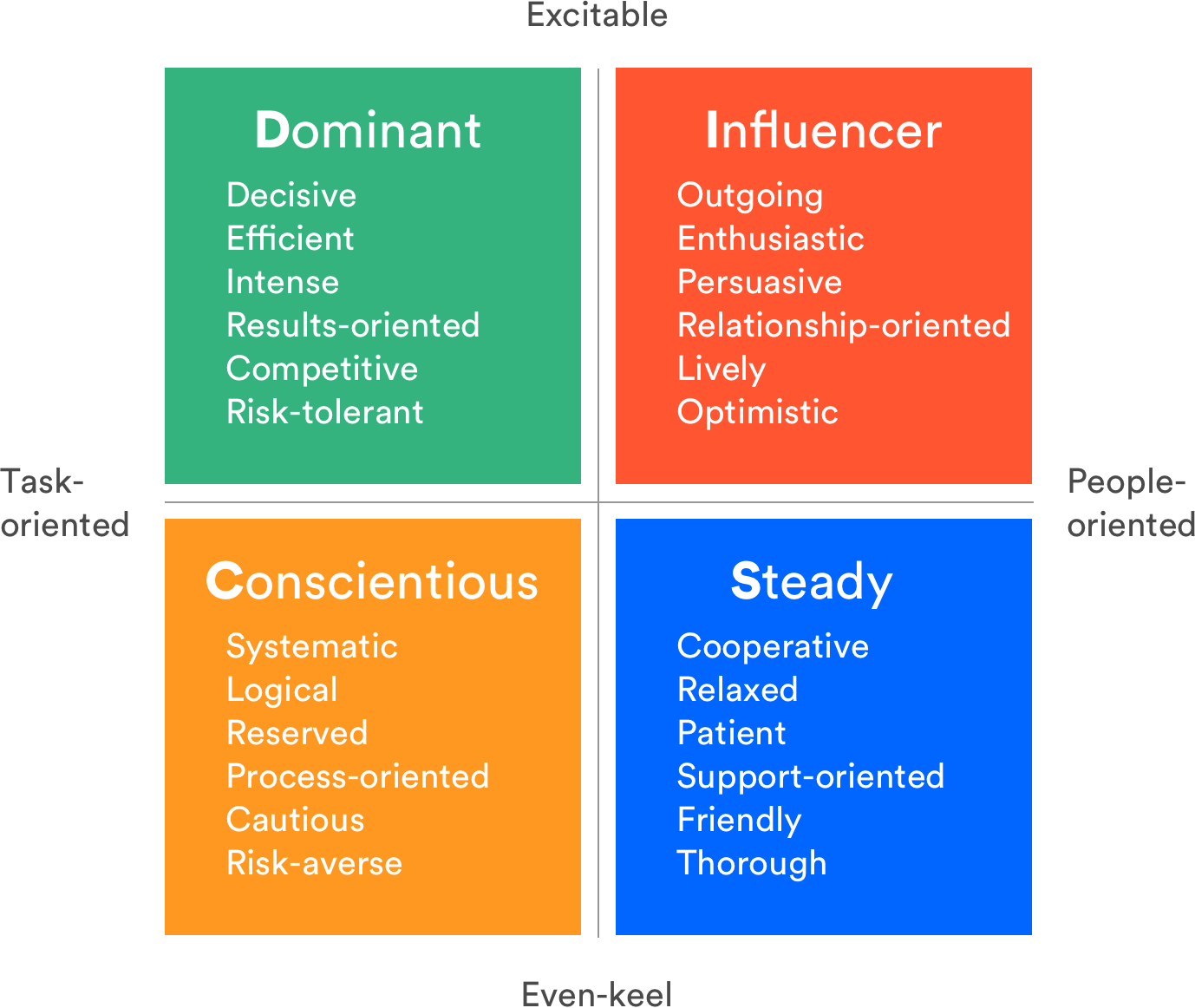
Many organizations use a four-style framework because it provides quick recognition. Think of it as a practical guide, not a label. People do switch styles, but they do have preferences.1. Direct and task-oriented
This style communicates concisely, concretely, and with a focus on progress. You’ll hear lots of statements and few detours. In meetings, they focus on decisions, deadlines, and tasks. In feedback, they’re clear and sometimes direct. Collaboration goes smoothly when everyone wants to move things along. Friction arises when others first need context or buy-in.2. Analytical and structured
This style demands facts, substantiation, and logical steps. You’ll often see questions, checklists, and scenarios. In discussions, they want to address risks upfront. In feedback, they use examples and nuances. Friction arises when others expect speed, while they first want “accurate” input.3. Relational and supportive
This style pays attention to atmosphere, timing, and support. They gauge the mood, listen carefully, and build bridges. In feedback, they often opt for gentler phrasing and questions. Friction arises when directness is perceived as harsh, or when the team wants to move quickly while they prefer a calmer approach to the interaction.4. Expressive and Persuasive
This style communicates energetically, associatively, and through storytelling. They create momentum, inspire enthusiasm, and make topics open for discussion. In feedback, they use a lot of emotional language and examples. Friction arises when others feel details are missing, or when structure is needed and the conversation becomes disjointed. Would you like to see how this translates to HR applications, including recruitment and development? On the assessment overview, you can see which scans and questionnaires are suitable for these purposes.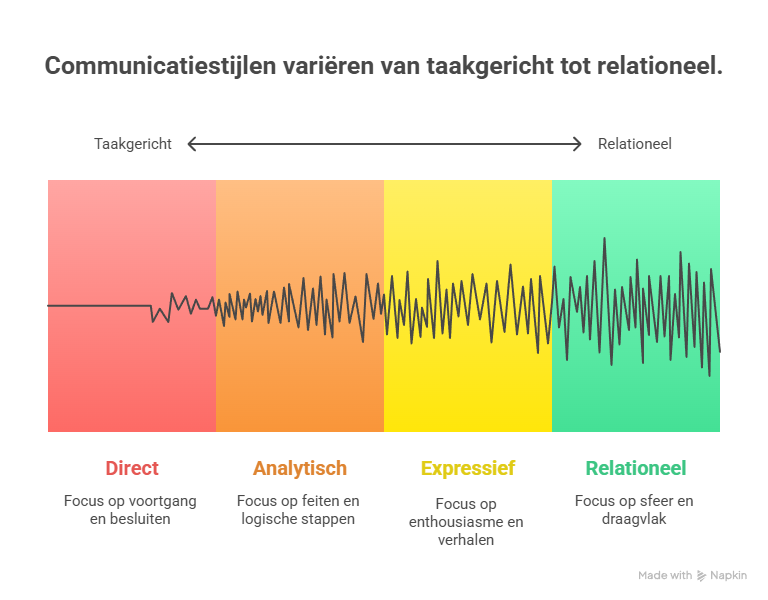
Why do communication styles clash so quickly-even among smart professionals?
Miscommunication is rarely about intellect. It’s about assumptions. People fill in the gaps with their own preferences. A direct person thinks, “I’m being clear.” A relational person hears, “I’m being criticized.” An analytical person thinks, “I want to weigh this carefully.” A task-oriented colleague hears, “He’s holding me back.” There’s a second factor at play: stress. Under pressure, people fall back on their preferred style. Direct becomes more direct. Analytical becomes more cautious. Relational becomes more conflict-averse. Expressive becomes more verbose. That pattern is predictable, and that’s precisely why you can make agreements about it. If you want to make that predictable behavior visible in advance to teams or leadership, an approach using online assessments as a starting point for the discussion can help.How can you identify communication styles in 10 minutes during a meeting?
You don’t need to test anyone to spot the first signs. Pay attention to four observation points: pace, level of detail, phrasing of questions, and response to resistance.- Pace: Does someone speak quickly and wrap things up, or do they build their argument step by step?
- Level of detail: Does someone stay at a high level, or do they want numbers, examples, and definitions?
- Question format: Does someone ask a lot of “what are we going to do” questions, or “why” and “what if” questions?
- Resistance: Does the person become more forceful, quieter, more cautious, or, on the contrary, even more persuasive?
How do you use communication styles in recruitment without falling into “typecasting”?
In recruitment, you don’t want to assume “the right style,” but rather increase the likelihood of success. You do this by linking communication style to context. What does the role require? Many stakeholders? Then you’ll often benefit from coordination and influence. Many incidents and operational pressure? Then clear, rapid communication helps. High risk and compliance requirements? Then structure and attention to detail help. Practical approach in interviews:- Ask for a recent example of friction in collaboration. What happened, in their own words?
- Ask what someone does when there’s no time for consultation. What do they say, word for word?
- Ask how someone gives feedback to a colleague who reacts defensively.
What role do communication styles play in feedback and annual reviews?
Many annual reviews fail not because of content, but because of form. The message doesn’t get through because the style clashes with the recipient. A direct conversation can be enlightening for one person, while for another it feels like rejection. A relational feedback session can feel safe for one person, while for another it feels vague. Therefore, establish guidelines on three levels:- Language: Speak in terms of behavior and examples, not labels.
- Structure: Start with the goal, then an example, then the desired change, then the agreement.
- Timing: Choose the right moment and channel. Some people want immediate feedback, while others prefer context first.
Which approach works in teams? A practical framework that HR can implement right away
Use the TTDV framework: Pace, Language, Detail, Form. This is a quick method for addressing differences without making anyone feel attacked.Pace
Agree on how quickly decisions are made. Establish a rhythm. First, assess the situation; then, make a decision. Teams without an agreed-upon pace become frustrated. One person finds it too slow; another finds it too rushed.Language
Agree on a framework. We’ll describe behavior and its effect. For example: “When you said X, Y happened, and I need Z.” This prevents discussions about intent.Detail
Define what “enough information” means. Analytical styles want the details; task-oriented styles want the essentials. Establish when to use which level of detail.Format
Choose the best format for each topic. One-on-one for sensitive feedback. In a team setting for process agreements. In writing for decisions. Verbally for tensions you want to resolve immediately. If you want to embed this framework with measurable insights, you can gather team or individual data through online assessments and then translate that into agreements during a team session.How do you link communication styles to assessment data?
The framework is most effective when you don’t view communication styles in isolation, but link them to underlying preferences. Consider decision-making behavior, stress responses, the need for structure, and social approach. This allows you to be much more specific in reports and conversations. For HR, this means:- You receive a prediction of behavior in challenging situations.
- You’ll receive coaching tools tailored to the individual.
- You can better assemble teams based on roles and collaboration.
FAQ on Communication Styles
What exactly are communication styles? Communication styles are preferred patterns in how someone speaks, listens, persuades, and reacts under pressure. It’s behavior you can observe in terms of pace, level of detail, and the form of feedback. Can you measure communication styles with a test? Yes, provided you measure behavior and underlying preferences. This allows you to identify differences and translate them into workplace agreements and development actions. The best-known test is the DISC test . Are communication styles the same as personality? No. Personality describes broader traits . Communication style is how those traits play out in interaction. The same person can communicate differently in a different role or context. Why does communication deteriorate as pressure increases? Because people fall back on their preferred behaviors. Direct communication becomes more concise, analytical communication becomes more cautious, relational communication becomes quieter, and expressive communication becomes more verbose. This is predictable, which is why you can make agreements about it. How do you prevent friction between a direct and a relational communication style? Make agreements about language and timing. The direct style addresses behavior and goals. The relational style checks how the message is received and what context is needed. It’s best to schedule difficult feedback one-on-one. What’s a quick team exercise to open up a discussion about communication styles? Use TTDV. Discuss Pace, Language, Detail, and Form. Have everyone name one preference for each component and establish team agreements based on those. If you want to back this up with data, you can start with online assessments . Does this also help with onboarding? Yes. New colleagues settle in faster when you make it clear how the team communicates. Include communication guidelines in the onboarding plan and link them to the first feedback sessions.In conclusion: 5 steps you can take this week
- Choose one team or department where misunderstandings frequently occur. Summarize the problem in one sentence.
- Use the TTDV framework in a short session and establish 4 concrete team agreements.
- Adjust your feedback format: Goal, Example, Effect, Agreement. Stick to observable behavior.
- Specify when to provide feedback in writing and when to do so verbally. This prevents endless threads and confusion.
- Support your approach with metrics. Start with the assessment overview and choose a path that fits your selection or development goals.
Put this insight into practice
Take the assessment directly, or discuss the right approach with a specialist.
Also interesting: Personality test: Big Five · Motivational drivers test · 360-degree feedback