
 Floor Hendriks
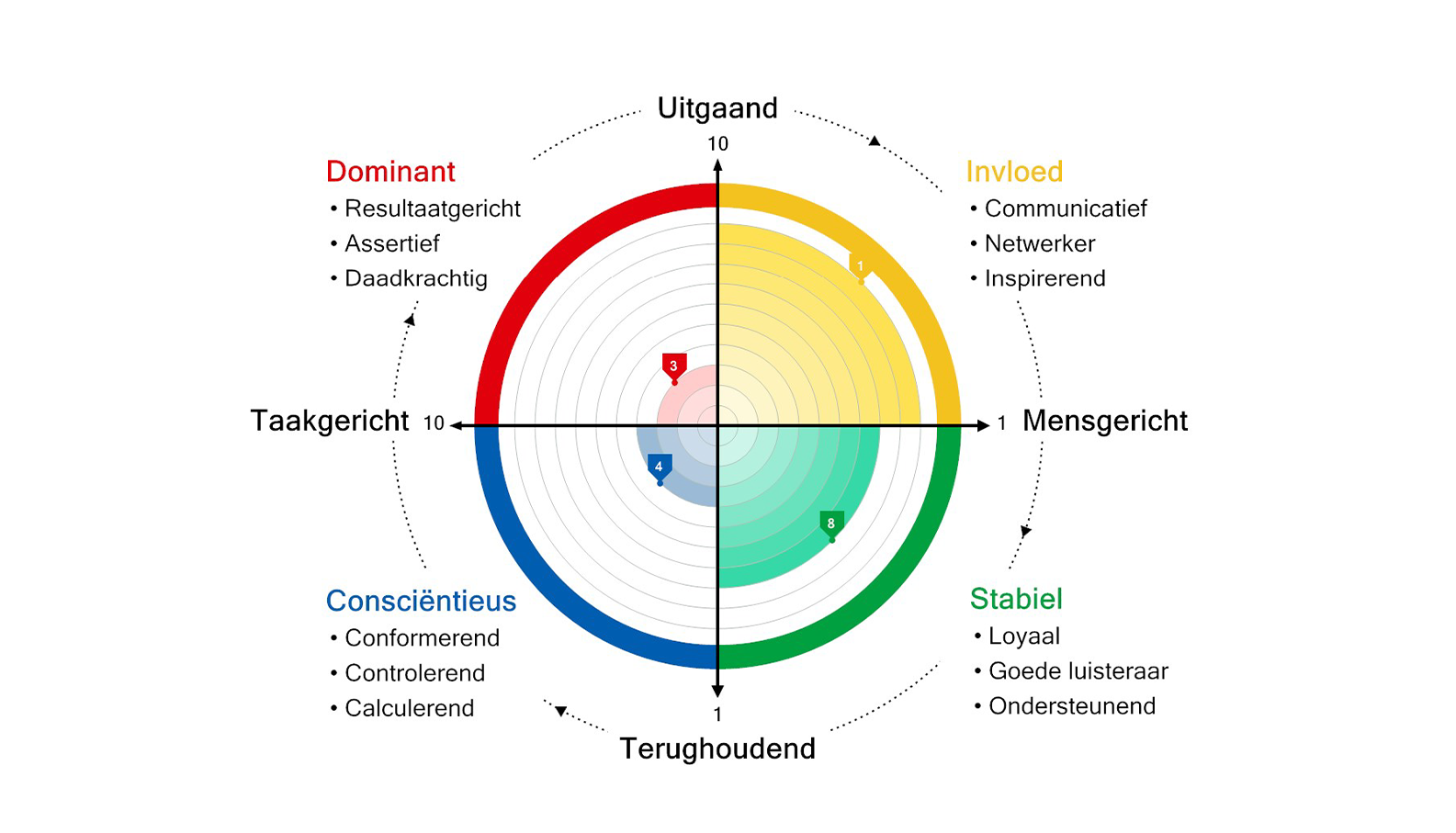
The DISC colors—red, yellow, green, and blue-provide a useful model for identifying behavioral and communication preferences. Rather than pigeonholing people, DISC shows which color or combination of colors matches your “nature.” This is helpful for personal development and teamwork.
A Brief Explanation of the DISC Colors
DISC test · from €94.00
Map behaviour, communication and collaboration.
Imagine this: you want to make quick decisions and take action (lots of red), while your colleague wants to get everyone on board first and seek harmony (lots of green).
Without an understanding of DISC colors, this can sometimes lead to frustration. Using the language of colors, you’ll see that you both contribute something valuable and learn to understand each other better.
- Red: Dominant & decisive (D) - Yellow: Influential & inspiring (I) - Green: Stable & supportive (S) - Blue: Conscientious & analytical (C)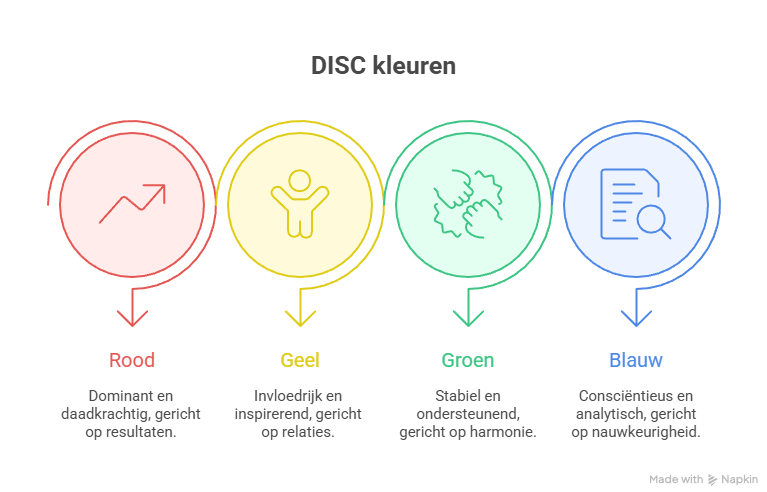
What You’ll Learn in This Article
- Exactly what DISC colors are and how the model is structured
- The four DISC colors (red, yellow, green, blue) explained in simple terms
- A short DISC color test to discover your preferred color
- Practical applications in teams, leadership, and recruitment & selection
- Common misconceptions about DISC and how to use the model correctly
What is the DISC model, and how do DISC colors work?
The DISC model is based on the work of psychologist William Moulton Marston. He identified four behavioral tendencies:
- Dominance
- Influence
- Steadiness
- Conscientiousness.
The test does not measure intelligence or talent. DISC looks at your preferred behavior: how you communicate, make decisions, respond to pressure, and collaborate with others. Everyone has all four colors within them, but usually one or two colors stand out the most.
The major advantage of working with DISC colors is their simplicity. Colors are easy to remember and serve as a neutral language for discussing behavior. Instead of saying, “You’re difficult,” you can say, “You’re exhibiting a lot of red behavior right now.” This makes conversations less personal and much more constructive.
Discover your DISC color profile
The four DISC colors explained
Keep in mind that every person possesses all the colors, but certain colors sometimes come to the fore more often.Red: Dominant, direct, and results-oriented (D)
People with a lot of red in their DISC profile like pace, clear goals, and tangible results. You easily take the lead, speak your mind, and like it when things happen quickly.
In meetings, you get right to the point. You ask, “What are we going to do?” instead of “How does everyone feel about this?” You can be firm in your communication, especially when plans are delayed or others keep getting bogged down in details.
The strength of red is decisiveness, the ability to make decisions, and a focus on performance. The pitfall is that you can sometimes come across as overly direct or impatient. Consciously giving space to green and blue colleagues helps you make better decisions together.
Yellow: Influential, enthusiastic, and inspiring (I)
Yellow DISC colors represent energy, ideas, and connecting with people. You’re often optimistic, enjoy talking, and quickly spot opportunities. Presenting, networking, and getting others on board with a story come naturally to you.
In groups, you’re quick to speak up. You connect people, crack jokes, and enjoy thinking out loud. Rules and details can slow you down, especially if they interrupt your creative flow.
The strength of yellow is influence, inspiration, and creating momentum. The pitfall is that you sometimes fail to follow through on commitments or take on too much at once. Collaborating with blue and green colleagues helps ensure structure and continuity.
Green: Stable, loyal, and supportive (S)
People with a lot of green in their DISC profile value stability, collaboration, and mutual trust. You’re often calm, patient, and focused on creating a pleasant atmosphere.
You’re a good listener, help your colleagues, and believe it’s important for everyone to feel seen. When changes occur, you first consider the impact on people, not just goals and numbers.
The strength of green is loyalty, team spirit, and reliability. The pitfall is having difficulty saying “no” or avoiding confrontational conversations. You can learn from red colleagues to make decisions more quickly at times and set clear boundaries.
Blue: Conscientious, analytical, and precise (C)
Blue DISC colors represent quality, logic, and structure. You like to work meticulously, verify information, and want to understand exactly how things work.
You ask critical questions, pay attention to details, and dislike sloppiness. In conversations, you prefer to let facts speak rather than emotions. You want to think things through carefully before taking a position.
The strength of blue is reliability, clear analysis, and high-quality standards. The pitfall is that you may come across as slow or aloof, especially to red or yellow colleagues. Consciously explaining why you ask questions helps prevent misunderstandings.
Request your DISC color report
How does a DISC color test work?
A DISC test consists of statements or sets of words where you indicate what best and least suits you. Often, you describe how you see yourself in work situations. There are no right or wrong answers: it’s about your natural preferences.
Your answers are converted into scores on the four scales (D, I, S, and C). Those scores are then translated into your DISC color profile. Most people recognize themselves in a combination of two dominant colors.
A professional report not only shows which color(s) suit you, but also how you communicate, what you need from others, what causes you stress, and where your talents lie.
On this page, you can take a free, short color test.DISC Colors in Teams and Collaboration
It’s interesting to know your DISC colors, but what matters most is what you actually do with that information.Understanding Team Dynamics
In a team with a lot of red, the goals and results are usually clear-cut, but the atmosphere can be tense.
In a team with a lot of green, the atmosphere is often excellent, but difficult decisions are sometimes put off. By mapping out the DISC colors, you can see where tensions and opportunities lie.A balanced team combines colors: red for direction, yellow for energy, green for support, and blue for quality. Discussing colors prevents differences from becoming personal.
Distributing Tasks Wisely Based on DISC Colors
For example, have red team members monitor deadlines and make decisions.
Yellow team members can give presentations, facilitate brainstorming sessions, or scout out new opportunities. Green team members excel at onboarding, coaching, and customer relations. Blue team members oversee scheduling, quality, and risks.By assigning work based on DISC colors, you increase both engagement and results. People do what energizes them and what they’re good at.
Leadership and DISC Colors
Leaders often exhibit a mix of colors but usually have a preferred style.
Red leadership is direct and decisive; yellow leadership is inspiring and motivating; green leadership is coaching and caring; blue leadership is analytical and meticulous.Effective leaders know their own profile and tailor their style to others.
For example, a green team member needs more time and support during change than a red team member. Using the language of DISC colors makes this concrete and open to discussion.DISC Colors in Recruitment & Selection
In selection processes, a DISC color test helps to objectively assess behavior and potential. You can better determine whether someone is a good fit for the role, the team, and the manager’s leadership style.
It’s important, however, never to use DISC as the sole decision-making criterion.Always combine insights from DISC colors with experience, competencies, references, and a thorough interview. This prevents color profiles from being used as a “label” rather than as a development tool.
Use DISC colors in your selection process
Common mistakes with DISC colors
1. “You’re red, so…” DISC describes preferred behavior, not character. People are more than just one color. It’s a tool for understanding behavior, not a fixed label.
2. Confusing color with competence Red behavior doesn’t automatically mean good leadership, and a lot of blue doesn’t guarantee flawless analysis. DISC colors indicate how someone approaches things, not whether they’re capable of performing at a high level.
3. Focusing on only one color Most profiles are a mix. For example, someone might be red-yellow (direct and inspiring) or green-blue (caring and precise). It’s precisely these combinations that make DISC rich and useful.
4. Using DISC as an excuse : “That’s just how I am; I’m Red.” That phrase may sound tempting at times, but it doesn’t do justice to personal development. Understanding DISC colors is actually meant to help you become more flexible, not to justify behavior.
Frequently Asked Questions About DISC Colors
Can my DISC colors change over time? Your core preference often remains fairly stable, but nuances can shift due to new roles, experiences, and conscious development. Under stress, you may also exhibit different behavior than in relaxed situations.
Is one DISC color better than another? No. Each color brings both strengths and pitfalls. Successful teams need a variety of DISC colors, precisely to complement one another. The question isn’t which color is “good,” but which color is appropriate in the context.
Can I get some use out of DISC colors on my own without an official report? Yes. Simply having a conversation using color-based language provides a lot of insight. The mini-test on this page will help you get started. For deeper insights, graphs, and concrete development advice, a full test is highly recommended.
Is DISC the same as other color models?
There are several models that use colors. The basis of DISC colors lies in Marston’s four-factor model (D, I, S, C). Other models sometimes use different names or additional dimensions. It’s important to use the same terminology within a single organization.
Which DISC colors go well together? We wrote a special article to answer the question of which DISC colors go well together .Would you like to see your own DISC color profile and receive a report that you can apply immediately to your work, team, and career?
Put this insight into practice
Take the assessment directly, or discuss the right approach with a specialist.
Also interesting: Personality test: Big Five · Motivational drivers test · 360-degree feedback