

 Floor Hendriks
 The term “CanMEDS” is commonly used in nursing. It is also referred to as CanMEDS roles or competencies. The CanMEDS roles are primarily used by paramedical professions, but nowadays they are also applied to the Nurse Specialist Registry, the Long-Term Care Quality Registry, and the Healthcare Professionals Registry.
Of course, the question remains: what exactly are these CanMEDS roles, and what is their purpose?
[caption id="attachment_8414" align="aligncenter" width="300"]
The term “CanMEDS” is commonly used in nursing. It is also referred to as CanMEDS roles or competencies. The CanMEDS roles are primarily used by paramedical professions, but nowadays they are also applied to the Nurse Specialist Registry, the Long-Term Care Quality Registry, and the Healthcare Professionals Registry.
Of course, the question remains: what exactly are these CanMEDS roles, and what is their purpose?
[caption id="attachment_8414" align="aligncenter" width="300"]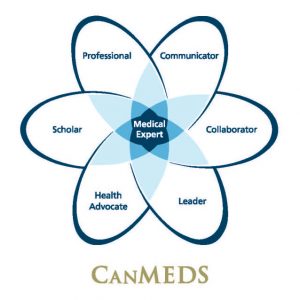 Source: Royal College of Nursing, Canada[/caption]
What are CanMEDS roles?
The Development of the CanMEDS Competencies: The 7 Roles
In any case, it is important to know which topics such an activity should cover in order to develop specific competencies. An overview of these competencies and a few examples is therefore in order here:- Professional Practice—Have I acquired knowledge about caring for clients or patients?
- Communication—Have I acquired knowledge regarding interaction with clients or patients?
- Collaboration - Have I acquired knowledge about collaborating with healthcare providers, as well as patients and clients, and healthcare institutions?
- Science and Knowledge - Have I learned more, enabling me to reflect on my professionalism and the reasons behind my actions?
- Socially Responsible Action - Have I learned more about social contexts and health-promoting measures?
- Organization—Have I gained more knowledge about how care can be organized?
- Quality and Professionalism - Have I learned more about professional standards and quality assurance?
The Importance of CanMeds Competencies in Nursing
It goes without saying that the healthcare sector is one of great social value, both for healthcare institutions and providers, as well as for the patients themselves. The CanMeds aim to further refine the competencies that are crucial for the development of an improved healthcare sector, so that the care provided to those who need it is of higher quality and more professional. In addition, CanMEDS provide insight into the current state of healthcare providers’ competencies, enabling all necessary improvements to be implemented.CanMEDS Competencies Within Your Organization
By using a 360-degree feedback CanMEDS questionnaire, your employees receive better feedback, allowing them to develop more quickly and improve the quality of care. Additionally, you can better assess your employees’ performance.CanMEDS in 2025: More Relevant Than Ever?
By 2025, the CanMEDS competencies will have gained an even more prominent position in the healthcare sector. The seven roles now form the foundation for virtually all quality systems and educational programs, such as higher professional education (HBO V).
Due to the increasing digitization and personalization of healthcare, the roles of Communication and Social Engagement, in particular, have expanded further. Healthcare professionals must now be skilled in both physical and digital communication, regularly switching between different platforms.
The integration of artificial intelligence into diagnosis and treatment plans has transformed the “Science and Knowledge” competency. Critical thinking and digital literacy have become essential for effectively utilizing technological tools without losing sight of the human element.
The experience of the pandemic has led to a renewed appreciation for the “Collaboration and Organization” competencies. Healthcare professionals now collaborate much more flexibly in changing teams, both within and outside the traditional healthcare setting.
The Quality Registry has also adapted. Higher standards are now set for the distribution of accreditation points across the various competency areas, with special attention given to the integration of these skills into daily practice.
As a result, the CanMEDS roles have not only remained relevant but have taken on an even more central role in 2025.
Put this insight into practice
Take the assessment directly, or discuss the right approach with a specialist.
Also interesting: Personality test: Big Five · Motivational drivers test · 360-degree feedback