
 Floor Hendriks
 More and more companies and organizations are saying goodbye to the traditional performance review and evaluation meeting and are opting for a modern cycle of conversations.
But how do you implement this? Focus on employees’ talents and development through an ongoing dialogue with their manager, using goal-oriented coaching and clear performance agreements. But what do you need to make this happen?
More and more companies and organizations are saying goodbye to the traditional performance review and evaluation meeting and are opting for a modern cycle of conversations.
But how do you implement this? Focus on employees’ talents and development through an ongoing dialogue with their manager, using goal-oriented coaching and clear performance agreements. But what do you need to make this happen?
Are you looking for help modernizing your feedback cycle?
From Wanting to Doing
The old performance review and appraisal meetings no longer work. Many organizations want to modernize their performance review and appraisal cycles.
To do so, they’re considering ongoing coaching of employees with motivational and goal-oriented feedback to support their development. That sounds like a noble goal, but how do you make it happen?
After all, the review cycle itself isn’t employees’ “core business.” But in an accessible and organic way, awareness of their own development and performance can certainly be a point of focus-one they actively engage with on a regular basis.
Not because “the boss” requires it, but out of their own intrinsic motivation: because they want to do it themselves and see the value in it.
The main reason is that both employees and managers find traditional performance reviews pointless. These concerns all emerged from seven years of research at VU University Amsterdam.
Researcher Kilian Wawoe wrote a book on this topic titled *The New Reward System*. In it, he advocates for the abolition of the “judgmental review.”
The demotivating performance review must be replaced by ongoing coaching with motivational feedback for employees. “Because the work environment has changed dramatically. We work in flatter organizations, more agile, more in teams, and we do more complex work,” says Wawoe.
Many HR professionals recognize the problem and are now looking for new approaches. The researcher (and HR instructor) advocates for a better evaluation cycle and a more modern approach to managing staff: more effective, fairer, smoother, with two-way communication in conversations, and more continuous dialogue between employees and managers.
For decades, the traditional meeting cycle went something like this:
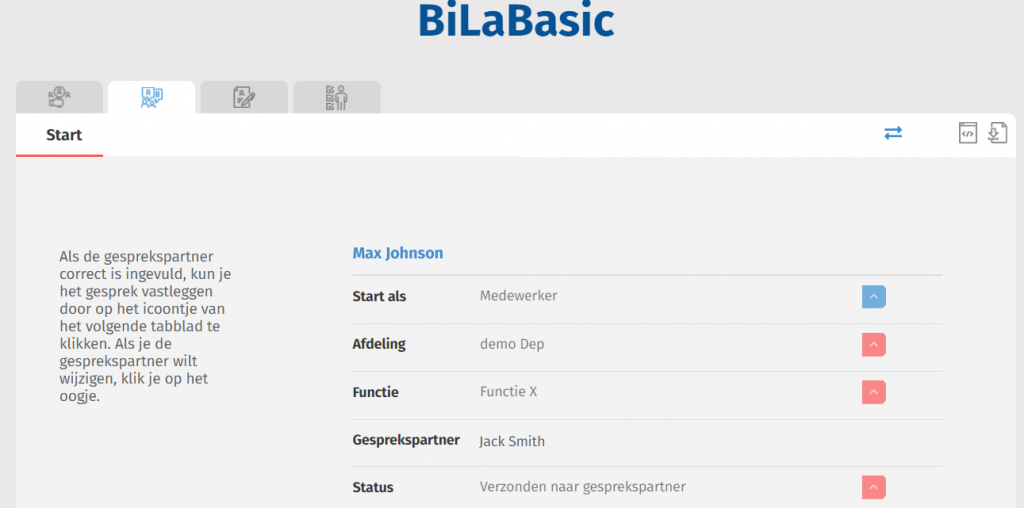
For example, we developed BilaBasic for a logistics organization’s operational staff. This includes, among other things, 5 questions on fundamental core topics that, based on online preparation by both the employee and manager, facilitate a productive conversation. This results in a concrete action plan.
 Another option is the Development Conversation. This agile development cycle was developed by hrmforce for a number of organizations that want to support professionals in their growth and development.
The employee is invited to reflect on his or her own development. Step by step, employees are guided through a process. The process can be initiated at any time and is based on the employee’s role, manager, competencies, and performance areas.
All development solutions can be combined with our psychometric questionnaires
.
Another option is the Development Conversation. This agile development cycle was developed by hrmforce for a number of organizations that want to support professionals in their growth and development.
The employee is invited to reflect on his or her own development. Step by step, employees are guided through a process. The process can be initiated at any time and is based on the employee’s role, manager, competencies, and performance areas.
All development solutions can be combined with our psychometric questionnaires
.
Be sure to consider these steps:
1. Start the dialogue
It begins with a dialogue between the employee and the manager about his (or her) talents, competencies, and ambitions. Where does the employee want to be in three years? And how can the organization help make those ambitions a reality?
And how do you give employees the insight needed to achieve that? Think about this and see how it can be incorporated into an individual’s personal development process.
Also consider how feedback questionnaires can support this process. This paves the way for motivating and goal-oriented feedback.
2. Set short-term performance goals
Those who opt for a modern performance review cycle aim to maintain a continuous dialogue with meaningful conversations and interactions between employees and managers.
Talent and (personal) development are central, but you also set performance goals. This is an important prerequisite for the new compensation system and for ensuring that the new agile review cycle remains goal-oriented and concrete.
Don’t just focus on the long term; above all, set short-term performance goals as well, for example, on a quarterly basis.
3. From Judging to Developing
When evaluating performance goals, the development discussion must remain the guiding principle. Avoid creating a new performance review-or even one that feels like a “judgmental” conversation.
Discuss openly and honestly what’s going well, what could be improved, and what’s needed to achieve the set goals. Don’t focus primarily on KPIs; instead, have a broad discussion about an employee’s results, competencies, and behavior.
This quickly shifts the focus away from thinking in terms of “right or wrong” toward the employee’s talents and the targeted support they need.
4. What tools are needed?
In addition to the resources employees need for their development, a modern performance review cycle also requires tools to ensure that the desired dialogue can be conducted effectively and flexibly.
For your employees and organization, consider which tools are needed for an agile development cycle and what, for example, the added value might be of modern feedback questionnaires
for the coaching dialogue between employees and managers.
After all, that is the new “holy grail.”
Why a modern performance review cycle?
This means that many organizations will have to make a significant shift. But why, exactly?| Problems with traditional performance reviews | Consequences |
|---|---|
| Waste of time and money | Inefficient HR processes |
| Demotivating and unfair | Lower employee engagement |
| No positive impact on performance | Stagnant development |
| Outdated work methods | Not suitable for agile organizations |
From Performance Review to Developmental Conversation
Modernizing the appraisal cycle is closely linked to how organizations evaluate their employees. For “the new approach to performance evaluation,” they want to look at employee performance in a different way.Traditional appraisal cycle vs. modern approach
| Aspect | Traditional approach | Modern approach |
|---|---|---|
| Frequency | 3 times a year (isolated) | Ongoing dialogue |
| Focus | Evaluation and Rewards | Talent and development |
| Conversation style | One-way communication | Coaching and Two-Way |
| Duration | Long and formal | Shorter and more accessible |
- At the beginning of the year, goals were set jointly during a goal-setting or planning meeting.
- Midway through the year, the goals were discussed in a progress review or performance review.
- At the end of the year, there was a “wrap-up” with an evaluation of the goals during a performance review.
Would you also like to conduct more coaching-oriented conversations?
360-degree feedback provides valuable input for development discussions
Solutions for a modern review cycle
Focusing on development discussions through a modern feedback cycle gives employees much more control over their own development. The review cycle encompasses all moments when managers engage with employees regarding their development. These no longer need to be strictly “formal meetings.” The dialogue can take a broader form. After all, a modern feedback cycle involves multiple touchpoints and is, above all, a flexible, customized approach for each individual. This requires an agile development cycle. Feedback questionnaires can be used to ensure truly valuable feedback-and to identify relevant discussion topics for the times when people actually speak with one another. It’s a waste of time to have to dwell on procedural “must-dos” or to first have to search for the most important topics of discussion. Fortunately, modern HR software can perfectly support the agile development and conversation cycle. This gives you a valuable tool, but organizations need to take further steps, because the software is merely a tool.Examples
A number of our clients have already adapted their cycle. The most important question they ask is: “Can’t it be simpler?” In practice, every organization wants to incorporate everything into a single appraisal system, and that’s precisely where the pitfall lies. Our experience has shown that it makes more sense to build it up or phase it out step by step and let employees get used to a modern appraisal cycle.BilaBasic for operational employees:
• 5 questions on fundamental core topics
• Online preparation by the employee and manager
• Facilitates a productive conversation
• Results in a concrete action plan
Another option is the Development Conversation. This agile development cycle was developed by hrmforce for a number of organizations that want to support professionals in their growth and development.
The employee is invited to reflect on his or her own development. Step by step, employees are guided through a process. The process can be initiated at any time and is based on the employee’s role, manager, competencies, and performance areas.
All development solutions can be combined with our psychometric questionnaires
.
Implementing a Modern Feedback Cycle
Anyone who wants to put people first must be able to flexibly align the organization’s entire development cycle with that goal. This allows you to move from a one-sided process driven by the organization or a manager to a more collaborative process. In this process, the manager and employee jointly determine the goals and direction, and they are also jointly responsible for them.4 Steps to a Modern Performance Review Cycle
| Step | Action | Tools |
|---|---|---|
| 1. Start the dialogue | Discuss talents, competencies, and aspirations | Feedback questionnaires, self-analysis |
| 2. Agree on results | Set specific quarterly goals | SMART goals, interim check-ins |
| 3. From evaluation to development | Focus on growth rather than evaluation | Coaching conversation techniques |
| 4. The Right Tools | Implement supportive systems | HR software, 360-degree feedback tools |
Ready for a modern performance review cycle?
Start with 360-degree feedback for valuable input into your conversations
The perfect foundation for development-oriented conversations
Put this insight into practice
Take the assessment directly, or discuss the right approach with a specialist.
Also interesting: Personality test: Big Five · Motivational drivers test · 360-degree feedback