
 Floor Hendriks
 The 360-degree feedback method is a powerful tool for better harnessing employees’ potential and improving their performance. Individual performance is assessed in an accessible way. Employees and their managers can then work together to gain a clear understanding of their talents and identify valuable areas for development.
This approach motivates employees to realize their potential and increase their contribution to the team. This article outlines the possibilities of 360-degree feedback. This way, you’ll know exactly what the pros and cons are and when it’s best to use this method in a company or organization.
In this article:
The 360-degree feedback method is a powerful tool for better harnessing employees’ potential and improving their performance. Individual performance is assessed in an accessible way. Employees and their managers can then work together to gain a clear understanding of their talents and identify valuable areas for development.
This approach motivates employees to realize their potential and increase their contribution to the team. This article outlines the possibilities of 360-degree feedback. This way, you’ll know exactly what the pros and cons are and when it’s best to use this method in a company or organization.
In this article:
- What Is 360-Degree Feedback?
- Characteristics of 360-degree feedback
- When should you use the 360-degree feedback method?
- When is it better not to use the 360-degree feedback method?
- Using 360-degree feedback with your own competency framework
- How does 360-degree feedback work in practice?
- Tools to Simplify the Process
- What are the benefits of 360-degree feedback?
- Does the method also have any drawbacks?
- Tips for implementing 360-degree feedback within your organization
- Conclusion
What is 360-degree feedback?
Put it into practice
Leadership test · from €74.00
Insight into leadership styles and management roles.
[ps2id id='360-versus' target=''/]
With 360-degree feedback, employee performance is evaluated by multiple people they interact with, such as their manager, colleagues, suppliers, or customers. There are various ways to provide feedback to employees.
This can be one-way (one-dimensional feedback) or take the form of a conversation in which the employee is also given the opportunity to provide their own input (180-degree feedback).
In 360-degree feedback, more than two people provide input about the employee. This allows the employee to receive feedback from different perspectives, creating a more complete picture of the employee and their performance in the workplace.
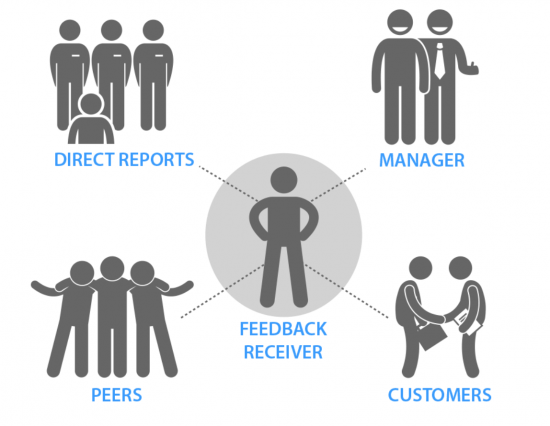 Image: cognology.com.au
The Characteristics of 360-Degree Feedback
[ps2id id='360-kenmerken' target=''/] The most striking characteristic of 360-degree feedback is the involvement of multiple people in this method. This allows multiple individuals with different perspectives to paint a complete picture . The employee is not a passive participant in this process either. He or she also has the opportunity to articulate and defend their performance . By comparing this perspective with the views of others, a learning process is set in motion. This gives the employee a clear picture of their strengths and areas for improvement. As a result, this is a motivational method that focuses not on weaknesses, but rather on an employee’s opportunities and potential. Image: cognology.com.au
When should you use the 360-degree feedback method?
[ps2id id='wanneer-gebruiken' target=''/] This feedback method is valuable for developing a modern cycle of dialogue between employees and managers, as well as for objectifying and preparing substantive performance or evaluation reviews. In many organizations, these discussions take place only once a year. To fully leverage the potential of 360-degree feedback, it’s recommended to schedule sessions several times a year . For example, once a quarter or even once a month. This can also be done through shorter-and often more informal-conversations. This keeps employees engaged and motivated to continue developing themselves. The method is also well-suited for peer review or for pre- and post-assessments in training programs.
Using 360-Degree Feedback with Your Own Competency Language
[ps2id id='competency-language' target=''/] Unambiguous competency language is a valuable tool for conducting effective (competency-based) conversations. It ensures everyone speaks the same language and helps prevent misunderstandings. Competency terminology clearly defines which definitions of competencies you use and what behaviors correspond to them. This is also valuable when using the 360-degree feedback method. At hrmforce, we create fully customized competency language for many organizations so that it aligns perfectly with their internal language and terminology. Organizations can develop or adopt a competency lexicon themselves, as standard lexicons are also available. Those who use hrmforce’s tools can utilize a standard competency lexicon (with a competency handbook) in addition to their own organizational language. This framework consists of approximately 50 competencies (based on the Big50) that make behavior measurable and discussable.When is it better not to use 360-degree feedback?
[ps2id id='when-not-to-use' target=''/] Sometimes this feedback method is also used in recruitment or selection processes. However, that is not its intended purpose. What is essential is feedback from people who are close to an employee, work with them frequently, and therefore know them well. This makes the method unsuitable for new evaluation situations, such as the recruitment or selection process. The method is also not intended as a “psychological test.” Of course, a psychological test can be used independently of the 360-degree feedback method.How does 360-degree feedback work in practice?
[ps2id id='in-de-praktijk' target=''/] There are various ways to implement 360-degree feedback in practice. For example, by collecting feedback via a (digital) questionnaire or in a face-to-face conversation. The latter option is called a roundtable discussion. Both methods have advantages and disadvantages. Feedback is always a standard part of the process.The (digital) questionnaire
The simplest and most accessible way to implement this method is with a 360-degree feedback questionnaire. You can choose between a digital or a paper questionnaire. The questionnaire can address general (work) performance or a specific aspect of job performance. The questionnaire is completed by the employee and a selected group of people who know the employee well and work closely with them. A drawback of this method is that a manager must wait for the results and then set aside time to review them.The Roundtable Discussion
Some employers prefer a roundtable discussion in which feedback on an employee’s (work) performance is provided in a structured manner. In this format, everyone sits together at a table and provides direct feedback. This can be confrontational and stressful for some employees. Completing a (digital) 360-degree feedback questionnaire prevents this situation. The advantage of this method is that you have everyone together in one location. This allows for interaction among participants. Uncertainties can be clarified, and viewpoints can be discussed. Additionally, you spend less time collecting and processing the results.The Feedback
After the feedback is collected, an employee’s results are compared with those of the feedback providers. This allows the employee to see where the similarities and differences lie. He can then work with his manager to set one or more goals to improve his performance or take it to the next level. A personal goal helps employees to (continue to) improve themselves
Tools to simplify the process
[ps2id id='simplify-process' target=''/] Fortunately, you don’t have to create the questionnaires yourself. Once you’ve determined the topic of the questionnaire, there are standard online questionnaires available that you can use right away. There are also companies that focus entirely on developing software to simplify the process for you as a manager. You can choose to use this software and/or these services to save time. Of course, you’ll need to weigh the costs of such a service against the benefits, but it’s always a good idea to explore the options for outsourcing the logistical aspects of the 360-degree feedback method.What are the benefits of 360-degree feedback?
[ps2id id='benefits-360' target=''/] The biggest advantage of 360-degree feedback is that an employee receives feedback from people they work with on a daily basis—not just from the manager who (often only partially) interacts with the employee. This shifts the focus away from numerical results and toward talents, development, and opportunities. Through this feedback method, an employee can identify their own talents and weaknesses and develop themselves in specific, targeted ways in certain areas. Because it provides a broader perspective, 360-degree feedback has also proven to be a reliable method. Studies show that the results are accurate. Furthermore, it is an accessible and constructive method. It fosters a positive atmosphere by focusing on improvement rather than “downgrading” a colleague. As such, it is also a process from which every participant can learn.Does 360-degree feedback also have disadvantages?
[ps2id id='disadvantages-360' target=''/] The success of the 360-degree feedback method depends entirely on the reliability of the people in the feedback group. It is important that these people provide honest feedback and do not act out of self-interest or excessive caution. Research has shown that the use of 360-degree feedback yields reliable results under these conditions. However, there may also be situations in which this method is not recommended. For example, a work environment that is highly competitive or hostile. Similarly, a department where a culture of fear prevails does not provide a suitable foundation for 360-degree feedback. The method works best in a work environment where people work as a team to bring out the best in themselves and in each other. And in a work environment where people want to develop talents to utilize them within the team.Three tips for implementing the 360-degree feedback method within your organization
[ps2id id='tips-360' target=''/] Now that you know more about how this feedback method works, you may want to implement it within your organization. However, its implementation does require some preparation. It’s important to establish the method firmly right from the start. Next, it’s essential to thoroughly prepare the substance of the process. Finally, it’s important to approach the process with a positive attitude. These three tips are explained in detail below.-
Introduce the method carefully and decisively
-
Set goals for the feedback and select the right feedback providers
-
Approach the process with a positive mindset
Conclusion
[ps2id id='conclusion-360' target=''/] When a manager evaluates an employee in a one-on-one meeting (using one-dimensional or 180-degree feedback), a one-sided view of the employee’s performance emerges. The manager usually doesn’t know the employee as well as colleagues who work with them on a daily basis. As a result, in a performance or evaluation meeting, the focus may end up being primarily on the results rather than on the process through which those results were achieved. By using 360-degree feedback, a more comprehensive picture of employees’ strengths and areas for improvement emerges. After all, you receive information about the employee’s performance from colleagues and managers who work directly with them. You can even involve a coach, suppliers, or customers in the process. By responding to the information obtained, you can make much better use of employees’ potential. The 360-degree feedback method is a powerful tool that allows you to bring out the best in your employees. This benefits not only the development of individual employees but also the team and, consequently, the company’s bottom line. Want to implement 360-degree feedback in your organization? Start the free demo here.Put this insight into practice
Take the assessment directly, or discuss the right approach with a specialist.
Also interesting: Personality test: Big Five · Motivational drivers test · 360-degree feedback