
 Floor Hendriks
 Organizations that want to take a targeted approach to their team and talent development often need a simple yet effective tool to assess the potential and performance of their employees. The 9-Box Grid Model has been a widely used tool for identifying and monitoring performance, talents, and potential for many years. In this article, you’ll learn how to use this tool and what key considerations to keep in mind when introducing it to your organization.
What is the 9-Box Model?
Put it into practice
360-degree feedback · from €114.00
Feedback from colleagues, managers and clients.
The “9-Box” is a relatively simple yet powerful tool for identifying, retaining, and developing talented employees. This can be done at both the individual and team levels. That’s why, in addition to talent development, it’s also valuable for team development or, for example, strategic workforce planning. The model maps out employees’ potential and talent and compares them to their performance. This makes it easier to identify high performers, “future leaders,” or potential successors for specific roles within a team. It also allows you to better identify which employees’ performance may still fall short of their potential and where there may still be opportunities for growth.
[caption id="attachment_20147" align="aligncenter" width="500"]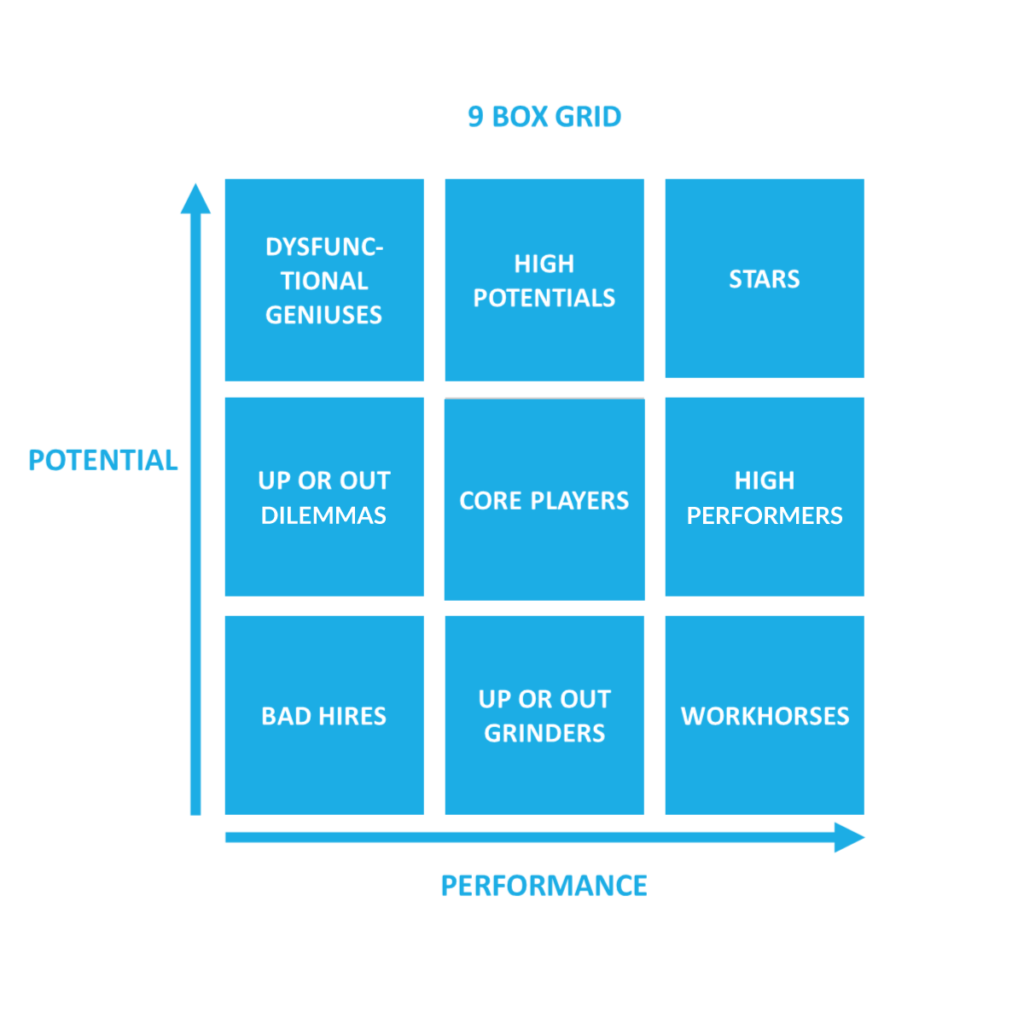 source: www.aihr.com[/caption]
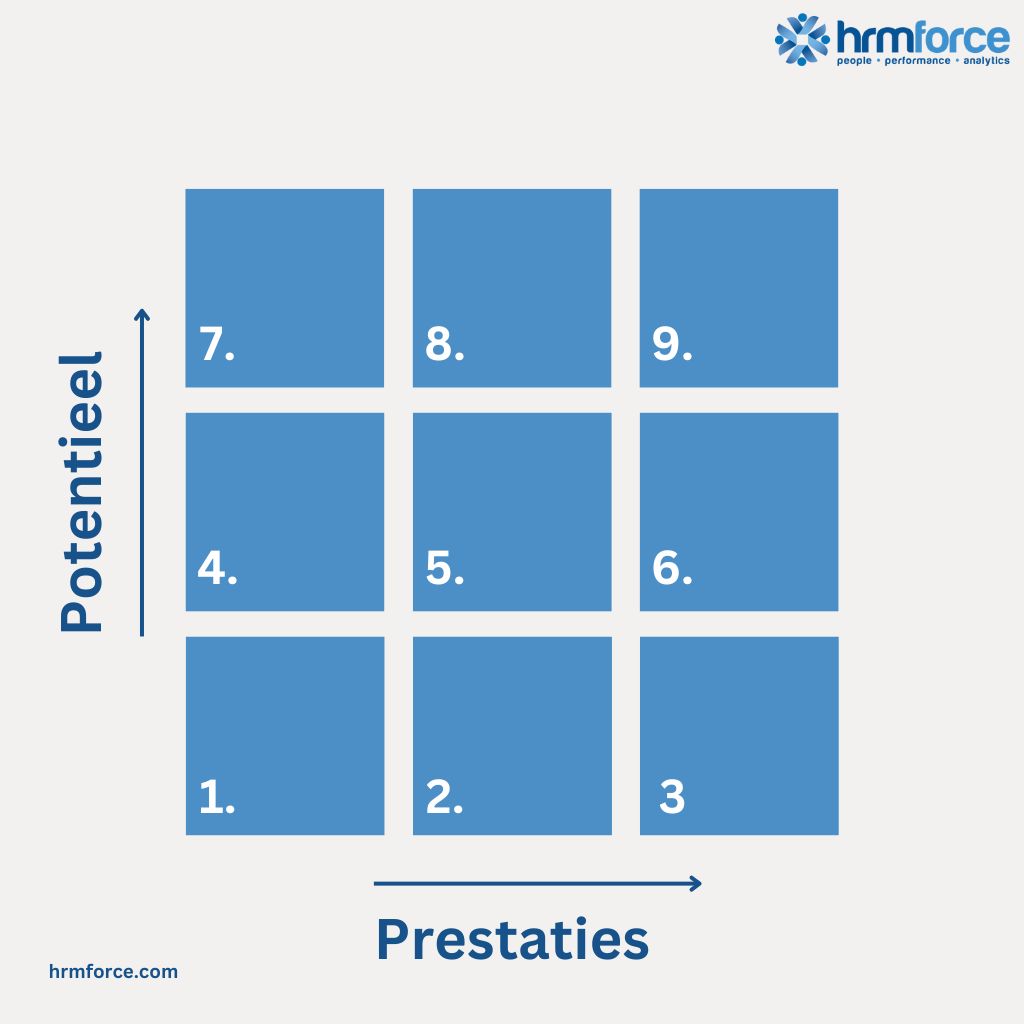
source: www.aihr.com[/caption]
Origins of the Model
The 9-Box Grid Model has been around for a long time. It was developed in the 1970s by the consulting firm McKinsey. It was initially used to compare business teams with one another. This allowed companies to better determine which business units required investment. Its use gained international recognition when the American company General Electric began applying it. The famous CEO Jack Welch placed strong emphasis on improving performance by attracting and retaining the right people. The model later evolved into a well-known HR tool for measuring the performance and potential of teams and individual employees.Using the 9-Box Matrix
Today, the model remains the most widely used performance matrix internationally. As a result, many internationally oriented companies also use it. For users of the hrmforce development platform, the 9-Box Matrix is available as a standard feature. This makes it possible to gain a clear overview of the entire organization or specific units relatively quickly. This is achieved by having managers evaluate employees according to the model along two axes: their potential and their performance. This creates a grid of nine quadrants into which employees are categorized. For each organization and team, you can specify who is authorized to assign scores and who can view the results.In this video, you’ll see how it works:
Using the Results
The results provide a quick overview of employees’ performance, talents, and potential. This is valuable for facilitating discussions among managers using a consistent framework. It helps ensure targeted investments in areas such as talent and team development. The results can also be used to foster constructive conversations between managers and employees, such as those focused on career development.Benefits of the 9-Box Grid Model
The 9-box grid offers several advantages for organizations that use it, including compared to other available models. Organizations that use it often cite these benefits for monitoring and facilitating talent and team development:- The simple model powerfully simplifies the identification of high-potential employees or potential leaders.
- It provides a standardized way to evaluate employees in their current roles. This makes it easier to assess performance and potential consistently and to compare employees.
- Talent identification: The 9-Box helps organizations identify high-potential employees so they can offer them the right resources and opportunities for further development.
- The model is transparent and provides employees with an honest view of how the organization assesses their potential.
- The model provides a valuable overview of the existing employee population at a glance. This enables organizations to optimize their talent management and make sound decisions regarding employee development and career planning.
- The model can help organizations set quality standards for employees and evaluate performance against these standards. This enables organizations to improve performance standards and encourage employees to reach their full potential.
- Recruit fewer new employees. With a better understanding of the existing workforce and its potential, it becomes easier to retain key talent, reducing the need to recruit them. This can help prevent high-potential employees from leaving.
Points to Consider When Implementing the 9-Box Grid
To get the most out of the 9-Box Grid Model as an organization, effective implementation of the approach is essential in addition to the online tool. To this end, discuss internally with teams why and how the model is used, as well as the criteria that play a role in the assessment. These criteria typically relate to both performance and behavior. Also specify what follow-up steps are taken after an employee has been placed in a particular quadrant. It should not become a “judgmental model.” Define and clarify the different quadrants of the model as well. After all, how do you define “low,” “average,” or “high” performance internally? Where possible, align these definitions with internal job or competency profiles. Keep the model up to date by regularly assessing employees’ performance and potential. Continue to adapt the model over time to the organization’s changing needs. Once all employees have received a score, it’s time to discuss the results. Managers gain valuable insight into the composition of their team in terms of performance and potential. These results provide a solid foundation for strategically advancing the team’s development and growth. After all, what does the team want to achieve in the future? The 9-Box Model can also help answer this question and provide a roadmap for achieving that goal.What do the 9 boxes mean?
The 9-Box classification model consists of nine boxes, each representing a specific combination of performance and potential. They’re almost self-explanatory, but at their core, they have the following meanings:- Box 1: Low Performance/Low Potential: These employees may not have the right skills or motivation to improve their performance and reach their potential. What does this mean for the future? Can the organization still help with their development?
- Box 2: Average Performance/Low Potential: Employees perform at an average level but show little potential for growth and development. The organization can explore ways to motivate these employees and support their development.
- Box 3: Low Performance/Average Potential: Performance is low, but there is potential for growth and development. The organization can help these employees develop, for example through training and coaching.
- Box 4: High Performance/Low Potential: When high performance is combined with little potential for growth and development, the organization can reward employees for their performance. However, it should also explore new ways to motivate and challenge these employees.
- Box 5: Average performance/Average potential: This group, which is quite average in terms of performance and potential, can be supported in their development by challenging them to reach their potential.
- Box 6: Low Performance/High Potential: There’s still plenty of room for improvement here! An organization can help these employees develop and challenge them to reach their potential.
- Box 7: High Performance/Average Potential: The organization can reward these employees for their performance and challenge them to further develop their potential.
- Box 8: Average Performance/High Potential: Employees perform at an average level but show great potential for growth and development. The organization can support these employees’ development and challenge them to reach their potential.
- Box 9: High Performance/High Potential: These employees are valuable assets to the organization! They should be encouraged and rewarded to reach their potential. The organization should also look for ways to involve them in the organization’s development.
Put this insight into practice
Take the assessment directly, or discuss the right approach with a specialist.
Also interesting: Personality test: Big Five · Motivational drivers test · DISC test