
 Floor Hendriks
Committed, happy, and enterprising people make up the organization-or rather, they are the organization.
…..“Good people make great business”…..
Nothing new under the sun
Focusing on how people function within organizations is nothing new. In a 2004 article, I came across twelve questions-which I consider simple-that still come up daily in my consulting practice:
An organization that pays attention to these aspects and facilitates development is generally a pleasant place to work. Organizational results improve when individuals feel a sense of ownership, collaborate with others, feel valued, and are continually challenged and given the opportunity to further develop themselves (Investors in People
).
 Each organization can adapt these elements to align with its own practices. I’ll explain three specific situations here.
The 12 Fundamental Questions for Employee Engagement:
- Do I know what is expected of me at work?
- Do I have all the resources I need to do my job well?
- Does my job give me the opportunity to do what I do best every day?
- Have I received recognition or praise over the past seven days for something I did well?
- Does my immediate supervisor-or someone else at work-care about me as a person?
- Is there someone at work who encourages my continued growth?
- Does my opinion matter at work?
- Do my organization’s vision and mission make me feel that my work is important?
- Do my coworkers strive to deliver high-quality work?
- Do I consider anyone at work a “good friend”?
- Has anyone talked to me about my performance over the past six months?
- Have I had the opportunity to learn new things and grow personally over the past year?
Source: Buckingham, M. and Coffman, C., *Break All the Rules*, Simon & Schuster, 1999, in: *Sigma* No. 6, December 2004
Developments
Of course, new insights are constantly being gained, and thinking about performance is constantly evolving. For example, over the past two years, many organizations have moved away from a practice that had become quite established: performance and evaluation interviews.| ❌ Old paradigm | ✅ New Paradigm |
|---|---|
| The performance review works terribly | The Good Conversation |
| A quarter of employees cry after a performance review | The 10 most important rules for a good conversation |
| Old-Style Annual Review | A weekly incentive to work from the heart |
Core principle: People want to learn and grow
For me, the format is less important than the twelve questions mentioned earlier. For me, the core is the belief in the intrinsic motivation of (most) people to learn, improve, achieve something, see results, and feel appreciated.🌱 What truly motivates people:
- 📈 Growth: Continuous development and new challenges
- 🏆 Results: A visible impact from their work
- 👥 Connection: Meaningful collaboration with others
- 💝 Appreciation: Recognition for contributions and efforts
- 🎯 Ownership: Autonomy and responsibility
Integrating Learning and Performance
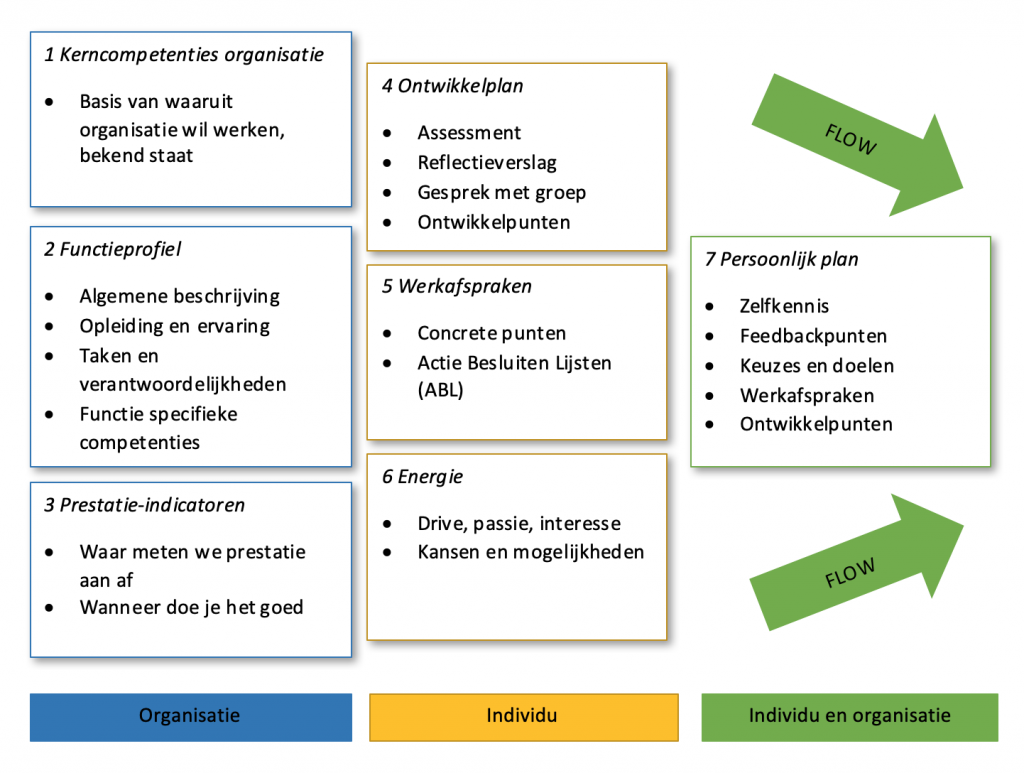
To prevent training from becoming too detached from work, focused attention is needed on integrating learning and performance. The image below lists elements that I regularly encounter in organizations. Central to this approach is working with a personal plan that combines job agreements with a personal plan or development plan (the well-known PDP). Individuals take ownership of that plan and are 100% involved in its creation.
Each organization can adapt these elements to align with its own practices. I’ll explain three specific situations here.
Three Practical Examples
1. Work Agreements at an Online Clothing Company
An online clothing company has used online assessments to determine each person’s personality and, based on that, to estimate whether it will be easier or more difficult for them to develop specific competencies.📊 Results:
- 100% participation: All employees volunteered to participate
- Increased self-awareness: Insight into one’s own strengths and weaknesses
- Better collaboration: Teams capitalized on each other’s strengths
- Clear agreements: KPIs linked to personal development
2. Reflection Report and Feedback at an Engineering Firm
An engineering firm that works with self-managing teams asked everyone to write a reflection report: to write a one-page A4 document about themselves and send it to their immediate colleagues or via 360-degree feedback.💡 Powerful reflection questions:
Looking back:
|
Looking Ahead:
|
3. Choosing Drive, Passion, and Interest
A highly experienced tax specialist at a large accounting firm is widely respected by colleagues and clients alike. His revenue is on target. His work-life balance is excellent. And yet, at some point, he finds himself sitting at home, feeling burned out.| Previous Situation | Transformation | Result |
|---|---|---|
| Burned Out Despite Success | A Choice for Professional Passion | In "flow" and full of energy |
| Unspoken expectations | Saying Goodbye to Tasks That Don’t Fit | Authentic leadership |
| Commercial pressure | Focus on knowledge sharing | Increased impact and revenue |
The secret to personal development
Successful personal development requires more than just good intentions. It requires a systematic approach that brings together various elements:🔑 Key factors for success:
- Ownership: Employees are personally responsible for their own development
- Ongoing dialogue: Not just once a year, but an ongoing conversation
- Personalization: Every person has their own motivations and learning style
- Integration: Learning and work are inextricably linked
- Support: The organization actively facilitates and encourages
Prerequisite: Genuine interest and truly listening
We’ve already discussed “the good conversation .” To develop personal plans that truly matter-for both the organization and the individual involved-it’s essential that we have meaningful conversations. This is not an annually scheduled, recurring conversation, but an ongoing dialogue (the frequency and follow-up may vary by person) based on evolving insights. What this requires: genuine interest and listening-truly listening. Celeste Headlee explains this excellently in the TED Talk below (12 min.).Start today with personal development plans that really work.
Invest in your people; invest in your future.
Put this insight into practice
Take the assessment directly, or discuss the right approach with a specialist.
Also interesting: Personality test: Big Five · Motivational drivers test · 360-degree feedback